Los Angeles
Station ElevenLos Angeles is where Arthur Leander’s career turns from precarious work into movie fame, and where he builds a conspicuously successful life with Miranda Carroll. The city’s parties, lights, and expanding opportunities make it feel at first like a place of possibility; its later associations include exhaustion, a troubled marriage, and the uncertainty of a flight that offers stranded passengers a chance to move west without promising safety.
Arrival and Acting Career
After graduating from theatre school in New York City, Arthur spends time auditioning and waiting tables. A recurring role on a Law & Order spin-off, commercials, and television pilots bring some work but no stable career. When a pilot fails to sell, its director suggests that Arthur come to Los Angeles, stay in a guest house, and audition. Tired of eastern winters, Arthur gives away most of his belongings and boards a plane west. His move is a deliberate break with an unsettled life, though the opportunity that prompts it is still only a promise to try again somewhere new.
In Hollywood, a small film role—as a soldier who appears briefly before being killed—leads to a much larger part. The work opens the way to parties that become increasingly frequent, and Arthur’s memories of this period return in abrupt, vivid episodes rather than as a steady account. At a Malibu pool, he speaks with a young woman who tells him she crossed the border from Mexico as a child concealed in a truckload of chili peppers. On another occasion, he rides through the hills in a convertible while his friends sing along to the radio. These glimpses make the city a sequence of encounters and nights out, as much as a career destination.
A chance meeting at a second party brings one evening into focus: Arthur recognizes a woman he had danced with the week before, and they watch the sunrise above Los Angeles from near Mulholland Drive. By then, the city’s novelty has begun to fade, but the view restores a sense that it still holds places he has not seen. The promise does not last. Six months later, during their breakup, the woman tells Arthur that loving Los Angeles does not mean he belongs there and mocks his hope of becoming a leading man. As Arthur approaches thirty, parties have grown repetitive, and he has twice waited in emergency rooms for news of friends who overdosed. A low-budget film about a botched bank robbery finally gives him a leading role, filmed in Toronto; he regards returning to Canada as a triumph, while recognizing the vanity in that feeling.
Fame, Home, and Marriage
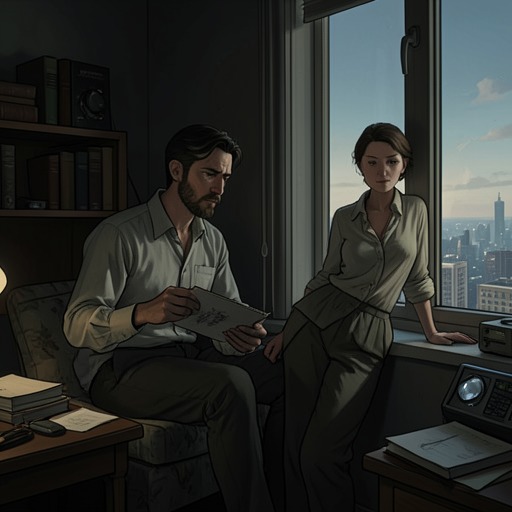
Arthur’s later Los Angeles life is materially different from the uncertain years of auditions. He and Miranda have a house in the Hollywood Hills and a Pomeranian, Luli, who appears as a small white shape in the darkness when Miranda calls for her at night. Photographers follow the couple in the street, leaving Miranda anxious and on edge. Arthur’s name now appears above his films’ titles, and by their third anniversary his face is displayed on billboards across the continent. Los Angeles has delivered the public recognition he once wanted, but its visibility also reaches into the couple’s private life.
The marriage ends amid the city’s celebrity machinery. Three months after a later point in their story, Arthur and Miranda are due to meet their lawyers to settle the divorce while paparazzi wait outside. Elizabeth Colton is preparing to move into the house, identifiable by the crescent-moon light beside the pool. Four months later, Miranda is back in Toronto, divorced at twenty-seven, and using her alimony to buy expensive clothes and consult stylists. She has come to think of clothes as armor. Her return to work at Neptune Logistics, followed by a career involving constant international travel, marks a different kind of independence from the Los Angeles life she has left behind.
The City in Arthur’s Memory
Los Angeles remains part of Arthur’s reckoning with his life even after it is no longer his home. At fifty-one, while preparing for King Lear in Toronto, he compares his present regrets with the things he wants to keep: among them, the pink magnolias in the backyard of the Los Angeles house. The detail survives alongside the larger events of his career and relationships. It locates memory not in fame alone but in a particular domestic place, preserved as one item in a list of what was good.
That recollection complicates Los Angeles’s earlier promise. Arthur had once described Toronto as the only place where he felt free, and later remembered Los Angeles as a place he loved; neither association settles whether success or belonging followed him there. The city holds both the visible evidence of achievement—his name on films and his image on billboards—and the smaller remembered garden that matters when he tries to distinguish a life from its regrets.
Los Angeles as a Possible Destination After the Collapse
After the Georgia Flu, Los Angeles becomes a hoped-for destination for people stranded at Severn City Airport. On the fifteenth day there, one of the three pilots offers a free flight west, explaining that his family is in Los Angeles and that he cannot accept the possibility of never seeing them again. His offer contrasts starkly with the former era of paid extras and upgrades for air travel. The passengers have had no news from outside since the televisions went dark, and they cannot know whether Los Angeles is safe. People with homes west of the Rockies mostly approach the pilot; many passengers from Asia also choose to go, hoping that the journey will bring them closer to loved ones.
At noon the next day, the departing passengers board by a wheeled staircase found in a hangar. The plane works its way between parked aircraft, leaving a gap between two grounded airliners, then takes off as the airport’s remaining population watches. Clark Thompson is moved by the sight of the aircraft rising into the clear sky after days of silence. Fifty-four people stay behind. The departure makes Los Angeles a concrete destination again, but the account establishes the offer and the plane’s successful ascent, not what awaits those aboard after they leave.
The airport also preserves the departure in a modest trace: Max has gone on the last flight to Los Angeles, but his American Express card remains at a restaurant in Concourse B. Clark places it in the display case that becomes the Museum of Civilization, beside a driver’s licence and other objects left behind. The abandoned card connects the city to both escape and absence: someone has flown toward it, while the people who remain assemble objects that stand for the lives and journeys disrupted by the collapse.
Aviation and the Changed Landscape
The meaning of Los Angeles as a place reached by air is set against the disappearance of ordinary flight. In the post-collapse world, airplanes still exist, but they sit dormant on runways and in hangars, their wings gathering snow. They have been put to improvised uses: aircraft near orchards hold trays of fruit to dry in the summer heat, and teenagers sometimes enter them. Rust spreads across the machines. The surviving planes are no longer a dependable network linking illuminated cities; they are stationary structures repurposed for immediate needs.
That change sharpens the importance of the airport departure. Before the collapse, flight meant looking down at towns from thirty thousand feet and imagining lives beneath their lights. At Severn City Airport, the few remaining passengers instead watch a single aircraft carry people toward a city whose condition they cannot verify. Los Angeles persists as a name associated with home, work, and reunion, while the means of reaching it have become rare and uncertain.